Good science starts by asking difficult questions with a well-posed experiment.”
Alexander Kane
PhD Candidate in the Materials Science and Engineering Department
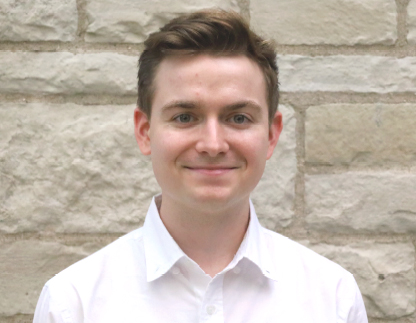
Alexander Kane is a PhD candidate in the Materials Science and Engineering Department in the McCormick School of Engineering. His research focuses on designing ionic diodes that mimic biological switches by using bio-inspired materials that regulate the flow of ions. Alexander is a recipient of a Ryan Fellowship.
How would you describe your research and/or work to a non-academic audience?
I design new materials that mimic biological mechanisms for information processing in soft electronics. I create microscale structures that contain positive and negative charges, known as ions, that can flow when and where I choose based on 3D printed designs.
Specifically, I create soft on-off switches, known as ionic diodes, that are more dynamic than traditional rigid diodes used prolifically in electronics. My main goal is to study the behavior of these ionic diodes to better understand how we might use them to emulate biological functions. Ultimately, these materials can help augment soft robots with sensors, brains, and batteries that interact with the world directly.
Whom do you admire in your field and otherwise, and why?
Adam Savage. He is one of the original cohosts of Mythbusters, the show that initially sparked my love of science. While Mythbusters is no longer running, Adam Savage still routinely posts YouTube videos where he dives into projects aimed at creating something new or testing an idea. One of his best qualities is how he details the creative process, even highlighting what could be done better next time.
How do you unwind after a long day?
I love to cook dinner for my fiancé, take my dog on a long walk, and play Mahjong online.
What books are on your bedside table?
I have an endless stack of books that are in varying stages of being read depending on the mood: Outlander (Diana Gabaldon), Chip War (Chris Miller), Sourdough Culture (Eric Pallant), and Bringing Down the Duke (Evie Dunmore).
What did you originally want to be when you grew up?
Like many young children, I loved to dig in the dirt. Except rather than filling toy trucks with dirt, I was much more fascinated by what I might find under the surface. Until I was in middle school, I wanted to be an archaeologist, with a focus on Egyptian archaeology. My favorite books as a kid revolved around Egyptian history or the pyramids.
What advice would you give your younger self or someone considering a similar path?
Be patient. Good science starts by asking difficult questions with a well-posed experiment. Great science iterates on the initial experiment tens or even hundreds of times until we can finally answer the original question and are left with even more unanswered questions. Patience, and the support of the community, are essential for staying sane throughout the scientific process.
What are you most proud of in your career to date?
I am most proud of the growth achieved by the Northwestern Research Program for High Schoolers (NURPH) that I led during my time as president. NURPH is a summer research program for local high school students that aims to build their confidence in and out of the classroom. It’s incredibly rewarding to watch high school juniors who have never even heard of materials science before excel at tackling research projects.
NURPH started with just three students in 2022 and is currently hosting seven in 2025. I am especially proud and thankful for the dedicated team of graduate students, past and present, that have helped NURPH become successful and help inspire the next generation of scientists.
Publish Date: December 16, 2025