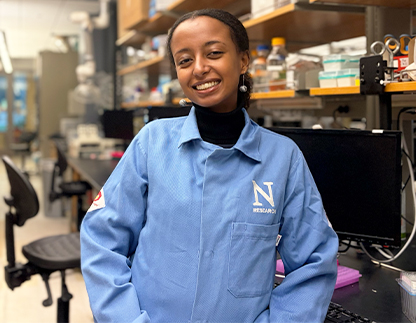
PhD Candidate in Chemical and Biological Engineering
“Being from Ethiopia, the opportunity to work with farmers in East Africa made the experience especially personal and rewarding.”
Herma Demissie is a PhD candidate in the Department of Chemical and Biological Engineering in the McCormick School of Engineering. Her research focuses on developing cell-free biosensors to detect health and environmental threats, including viruses, water contaminants, crop pathogens, and food micronutrients. Herma is particularly interested in creating practical diagnostic tools that can improve public health outcomes in East Africa.She is also a 2026 recipient ofthe Presidential Fellowship.
How would you describe your research and/or work to a non-academic audience? Cells have evolved over millions of years to sense and respond to their environment, making them powerful building blocks for diagnostics that detect threats to human and environmental health. These diagnostics can help identify harmful contaminants in drinking water or crop pathogens that reduce agricultural productivity. In my research, I take these cellular components outside of living cells and reengineer them into practical diagnostic platforms—"cell-free" biosensors—that detect a wide range of targets, with a particular focus on using these systems to improve public health outcomes in East African contexts. What have been some of the most memorable twists and turns of your career? As part of my research, I had the opportunity to work with farmers in Kenya to assess how well our biosensing platforms met their needs in real-world settings. Going into my PhD, I never imagined I would get to work on a project so closely connected to a part of the world I call home. Being from Ethiopia, the opportunity to work with farmers in East Africa made the experience especially personal and rewarding. What is the biggest potential impact or implication of your work? I’m particularly excited about working on diagnostic questions that have the potential to translate into real-world applications, especially in under-resourced settings. As scientists, we don’t always get to see our work move beyond the lab, so I’m really grateful for the opportunity to work at the intersection of fundamental science and translation. How do you unwind after a long day? Being close to a lake has its perks, so I love to go on long walks. I also enjoy reading and exploring new coffee shops in the city. Published Date: October 27, 2026