Power, Politics, and Sustainability: Lessons from a Global Energy Leader
Power, Politics, and Sustainability: Lessons from a Global Energy Leader
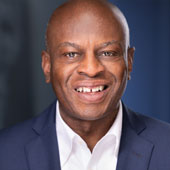 Tunde Onitiri brings a global perspective into the MSES classroom to teach the importance of building relationships among developed and emerging nations in the energy transition.
How challenging is it to ask government leaders of a developing nation that sits on a wealth of oil and coal to leave it in the ground?
Tunde Onitiri can tell you.
Onitiri, a Nigerian-born senior adviser on climate and infrastructure investments in emerging markets, has shared that message with leaders in his home country, advocating for innovative financing structures to fund decarbonization.
The question isn't whether countries should decarbonize. It's how governments, businesses, and investors create credible financial incentives to make that transition possible. That's the challenge Onitiri now explores with students in International Carbon Markets, where students explore how governments, businesses, and investors use carbon pricing and carbon markets to finance the global energy transition.
The course is offered in Northwestern's Master of Science in Energy and Sustainability (MSES) program, jointly offered by Northwestern Engineering and the Paula M. Trienens Institute for Sustainability and Energy.
“The energy transition solution is so different depending on whether it's the US or Canada or in Asia or any of the emerging markets,” said Onitiri, who has been teaching in the MSES program since 2023. “With emerging economies, they see using their natural resources as a way out of poverty.”
That reality sits at the heart of Onitiri's teaching. The challenge isn't simply convincing countries to reduce emissions—it's designing credible financial and policy systems that make cleaner alternatives economically viable while recognizing the vastly different priorities of developed and emerging economies.
Students explore those questions by examining carbon markets around the world, comparing compliance and voluntary systems, evaluating the integrity of carbon credit projects, and analyzing how policy, finance, and technology intersect to support global net-zero goals. Through case studies and market simulations, they grapple with the same tradeoffs governments and corporations face when balancing economic development with climate commitments.
That’s one of the main messages Onitiri imparts to his MSES students: Trying to separate politics from sustainable energy decisions, especially in emerging markets, is like trying to sift the flour out of an already-baked cake.
Rather than take on that fruitless task, Onitiri has made a career helping governments, investors, and business leaders navigate those political and economic realities to find rational and financially feasible pathways toward sustainable development. That career has quite literally spanned the globe.
Onitiri has worked in Angola, England, Mozambique, Nigeria, Singapore, and the US. His roles include time with the World Bank’s International Finance Corporation and Nigeria’s sovereign wealth fund, dubbed the Nigeria Sovereign Investment Authority (NSIA).
In that latter role, Onitiri served as special adviser on climate investments to the CEO, advising on strategic initiatives, including the development of an investment vehicle to mobilize financing for Nigeria's energy transition.
Nigeria is Africa’s largest oil producer and third largest producer of natural gas. Most of its oil is exported to other nations. It also has more than 600 million tons of known coal reserves.
Onitiri's experiences provide students with a perspective that extends well beyond textbooks. While carbon markets are often discussed in terms of economics and environmental policy, Onitiri emphasizes that every market reflects the priorities, constraints, and aspirations of the people and nations participating in it.
Above all, Onitiri wants his students to understand that successful climate solutions depend on more than sound engineering or strong economics. They require trusted relationships, credible institutions, and the ability to navigate competing political, financial, and cultural priorities across borders.
“Especially when you're dealing in emerging markets, you get into many situations where there are differences of opinion or frustrations,” Onitiri said. “You have to pay attention to those relationships and how to navigate them because you're dealing with such a wide range of individuals from different sectors, with different priorities and different perspectives, and you have to be able to navigate that.”