Finding a Bright Spot Amid Darkness
As a teenager in Ghana, Kwame Amoah (MSES ‘24) often found himself hunched over textbooks, straining to read by the dim flickering of oil lamps.
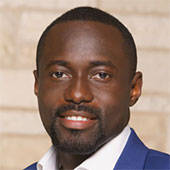 Power outages lasting up to 10 hours a day were a harsh reality in his native country, disrupting his studies and daily life.
From those outages came a newfound inspiration.
Today, Amoah is a senior distribution system planning engineer at Eversource Energy, New England’s largest energy delivery system operator. In that role, Amoah applies lessons learned from Northwestern University’s Master of Science in Energy and Sustainability (MSES) program to shape the future of the electrical grid. MSES is jointly offered by Northwestern Engineering and the Paula M. Trienens Institute for Sustainability and Energy.
At Eversource, Amoah is responsible for medium- to long-term grid planning.
“My role is basically to determine how we can best meet future energy demand," Amoah said. “Electrification is going to rise drastically. People are going to use more heat pumps, more electric vehicles are going to come on board, and so that in itself is going to have a big impact on the grid.”
A Life’s Journey
Amoah has wanted to make a difference in the energy sector since those days of studying in the dark.
“I have always had those experiences as a teenager in the back of my head as I’ve studied,” Amoah said. “They spurred me on and changed the course of my life.”
After working as a planning engineer in his home country for nearly six years, he sought to broaden his expertise by enrolling in the MSES program.
“Growing up, electrification was basically about giving people access to energy. Now the definition has changed to moving to cleaner energy sources,” Amoah said. “I wanted to have a good feel for this transition. I decided to take the MSES program to see how best I can infuse these new trends into the utility space.”
The program's comprehensive approach—combining the technology, finance, and policy aspects of energy and sustainability—was key to his decision to join MSES. The program helped him bridge the gap between what he knew in Ghana to what he needed to know for his future.
A Vision for New Opportunities
But the transition to studying in the United States came with its own set of challenges.
The program’s cohort structure proved invaluable, fostering a tight-knit community that helped international students like Amoah adjust quickly. He also took time to explore other facets of the energy transition through the program’s interdisciplinary pillars, discovering an interest in energy public policy—an area he was never exposed to before.
“That was never really a thing for me until I started the program," Amoah said. “After the program, I realized that, indeed, you need all three of [the program pillars]—policy, technology, and finance—to be able to successfully implement a new trend."
Now at Eversource, Amoah is applying these lessons directly to his work. He sees firsthand how new electrification trends impact the grid and works to ensure its reliability and resilience in the face of these changes.
He also issued a call for others to follow in his footsteps.
“Renewables come with their own challenges, and incorporating them in the grid is also very challenging,” he said. “We need a lot more engineers to address these issues so that the customer never feels the impact.”
From those dimly lit study sessions in Ghana to planning the future of energy distribution in the United States, Amoah's journey speaks to the complexities of the global transition and the critical role of innovative thinking to address energy challenges.
“I see real-time the impact of these new trends in the energy space,” Amoah said. “Being able to ensure that the grid is reliable and resilient— that’s exciting.”