Living a Dream that Almost Didn't Exist
Claire Miller (MSES ‘22) didn’t even know the role of microgrid solutions architect existed before she joined the MSES program. Now she’s on the front lines of an energy sustainability movement.
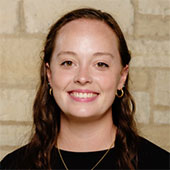 Claire Miller (MSES ‘22) is living her dream as a microgrid solutions architect at Schneider Electric, a global leader in digital transformation of energy management and automation.
It’s a dream that she didn’t know she had 4 years ago, before she became a student in Northwestern's Master of Science in Energy and Sustainability (MSES) program. MSES is a joint offering by Northwestern Engineering and the Paula M. Trienens Institute for Sustainability and Energy.
“I love it – absolutely love it,” said Miller, who stepped into her role in August 2022, immediately following her MSES graduation. “I'm actually helping projects get built, helping get renewable energy in the ground, and also helping really educate the industry on their options.”
She credits MSES director Holly Benz for where she is today.
Prior to joining MSES, Miller was an energy consultant, increasingly burnt out in her job. As the COVID-19 pandemic wore on, she decided to go back to school and pivot to a different field. She narrowed her educational options to two programs. One was MSES, and that led to a call with Benz.
“Holly stressed how MSES is career-focused and how much support the program provides to its students in their job search," Miller said. “Right afterward, I had a Zoom call with the director of the other program and I asked them about career services, and they had nothing.”
That’s how Miller found herself on Northwestern’s campus, in person more than a year after the pandemic started, working her way through the 10-month MSES program.
But Benz’s influence on Miller’s future wasn’t over.
“Holly was actually the one who introduced to me solutions [architecture] as a role,” Miller said. “I had never heard of it before the program, and I don't know if it's something that I would've gone for if I just read about it. Now that I'm doing it, it's my dream job.”
Miller's work involves promoting the adoption of microgrids. At its core, a microgrid is a small, local energy system that can work on its own or connect to the main power grid. It uses different energy sources, like solar or batteries, to keep power running for its customers (think manufacturing plants, military bases, disaster-prone neighborhoods, etc.), especially when the main grid goes down.
Microgrids are decentralizing the energy grid. By connecting distributed energy resources behind the meter, end users can sell energy while connected to the grid while also having the ability to "island" or disconnect from the grid when needed.
“I'm the first technical resource at the business development stage,” Miller said. “I'm the first person who comes and asks, ‘What are our goals? What are our resources? What's our budget?’ and then I try to get a solution around renewable energy that will fill all those buckets.”
Filling those buckets for more and more people has the potential to make a significant impact on the utility grid's reliability, resiliency, and sustainability. Electric utilities in the United States still generally rely on fossil fuels for the bulk of their electricity generation. Air pollutants like carbon dioxide, sulfur dioxide, and nitrogen oxides are emitted in the process.
Decentralizing the grid's generation through microgrids can increase sustainable energy source penetration while also increasing overall reliability and load stability.
It's been more than two years since Miller graduated, yet she remains grateful to the MSES program for helping her find, and preparing her to succeed in, her job.
“The best thing I took out of the program was the people and the relationships,” she said. “The program does a good job of bringing together a lot of passionate people who are trying to find a way to help. Learning from those folks is going to be very impactful for the rest of my life.”