Innovation Symposium highlights Northwestern’s growing role in quantum
At the inaugural Quantum Week, researchers, alumni, industry leaders, and national lab experts explore how breakthrough science can move toward real-world impact
As quantum science pushes beyond theory and into application, Northwestern is building on a growing set of strengths to contribute to this rapidly evolving field.
That was the clear message of the Quantum Innovation Symposium, a daylong event held April 22 at Guild Lounge as part of the University’s inaugural Quantum Week. Bringing together researchers, alumni, industry, and public-sector leaders, and national laboratory experts, the symposium explored where the field is headed and what it will take to turn quantum promise into practical impact.
Organized by the Institute for Quantum Information Research and Engineering (INQUIRE) in partnership with the Illinois Economic Development Corporation, the event focused on a challenge now shaping the field: how to connect advances in quantum science with the tools, partnerships, and use cases needed to make them matter. Across talks on computing, networking, software, commercialization, and collaboration, the day’s discussions underscored Northwestern’s growing role in that work.
Opening remarks from Michael Wasielewski, the Clare Hamilton Hall Professor of Chemistry and director of INQUIRE, and Northwestern Vice President for Research Eric Perreault framed the symposium around the value of interdisciplinary exchange. Wasielewski described Northwestern as “on the cutting-edge in this amazing developing field” and highlighted INQUIRE’s role as a hub for connecting researchers across schools, departments, and disciplines.
He highlighted INQUIRE’s core research thrusts — quantum sensing and materials, quantum computing, quantum communications and networking science, and quantum algorithms. Wasielewski cited affiliated centers, including the Center for Molecular Quantum Transduction, which he directs, and the Superconducting Quantum Materials and Systems (SQMS) Center at Fermilab, which benefits from significant participation by Northwestern faculty. He also emphasized INQUIRE’s education mission, including student enthusiasm for engagement efforts such as N’Tangled.
A field built on partnership
Preeti Chalsani, senior vice president and chief quantum officer at the Illinois Economic Development Corporation, expanded the conversation beyond campus, highlighting the broader quantum ecosystem taking shape across Illinois.
She described a powerful mix of assets already in place: leading research universities, national laboratories such as Argonne and Fermilab, advanced facilities for fabrication, materials characterization, metrology, and prototyping, and a strong talent pipeline. She also highlighted the state’s third-largest community college network in the country, underscoring its role in developing a skilled workforce in partnership with industry.
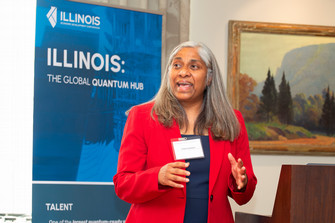
That broad foundation matters, she suggested, because quantum is still an emerging technology whose most important applications are not yet fully defined. Illinois, with its unusually diverse economic base, is well-positioned for that moment. Chalsani noted that if Illinois were a country, it would rank among the world’s top 20 economies, with nearly three dozen Fortune 500 companies, almost 60 Fortune 1000 firms, and more than 2,600 global companies. From chemicals, manufacturing, and pharmaceuticals to medtech, aerospace, automotive, and energy, many sectors are beginning to explore how quantum science could eventually create value.
She also cited the state’s $200 million investment in quantum science in 2019 as an unusually bold signal of intent, evidence, she suggested, of a determination to prove that emerging technologies need not take root only on the coasts. Quantum expertise, she said, does not come from any single discipline, making “powerhouse institutions like Northwestern” especially valuable.
Hardware is only part of the story
Among the day’s featured speakers was Northwestern’s Nikos Hardavellas, professor of computer science and of electrical and computer engineering, who turned attention to a part of quantum computing that often receives less notice than the machines themselves: software.
In his talk, The Hidden Engine of Quantum Computing: The Software Ecosystem, Hardavellas argued that the field’s future will depend not only on better hardware but also on the tools, systems, and expertise needed to make quantum computers useful in practice.
“There’s a lot of work that happens more on the hardware side of things, but without having use cases, without having algorithms that solve important societal problems, or problems that are highly relevant to industry, these systems won’t be able to find good use and reach their potential,” he said. In its current state, he added, “hardware alone cannot do everything.”
He pointed to one example of that challenge in the rise of chiplet-based quantum systems. As the field works to build larger, more powerful quantum computers, developers increasingly assemble them from smaller, interconnected modules, or chiplets, rather than from a single device. But today’s software was not designed with those modular systems in mind. When connections between chiplets are slower, uneven, or limited, performance can suffer — creating bottlenecks that affect both speed and accuracy.
Hardavellas highlighted SEQC, a new compilation approach developed by his research group to address that problem. Designed specifically for chiplet-based quantum systems, SEQC breaks the work into parallel steps and uses more efficient strategies to place, move, and optimize qubits. The result is a tool that compiles faster and produces more accurate circuits than conventional approaches that do not account for chiplet-based architectures.
That focus on application ran through the rest of the program. Laura Schulz, project lead for innovation at Argonne National Laboratory, discussed the relationship between quantum computing and classical supercomputing, while Caitlin Carnahan, vice president for quantum software at Infleqtion, examined how a full-stack approach can connect advances in neutral-atom hardware, software, controls, and systems architecture to real-world applications. Drawing on experience across physics, computer science, machine learning, and scientific computing, Carnahan emphasized quantum’s potential in areas such as health sciences, energy, and materials.
Inder Monga, director of Berkeley Lab’s Scientific Networking Division and executive director of the Department of Energy’s Energy Sciences Network, brought a systems and infrastructure perspective to the program. In his talk on distributed quantum computing, Monga described the development of the QUANT-NET testbed, a multi-node research platform designed to connect quantum processors over fiber networks. His remarks highlighted the growing importance of networking, control architecture, and interoperability as the field looks beyond monolithic systems toward large-scale distributed quantum computing.
Additional talks by Heejeong Jeong of Pasqal, Abhinav Kandala of IBM Quantum, and Elena Glen of Quantum Machines added perspectives on hardware, networking, infrastructure, and applied research.
A panel on quantum computing use-case development, moderated by Northwestern assistant professor Kate Smith, pushed the conversation even further toward implementation. Panelists explored how researchers and companies can identify meaningful applications, better align advances in hardware and software, and build systems capable of solving useful problems.
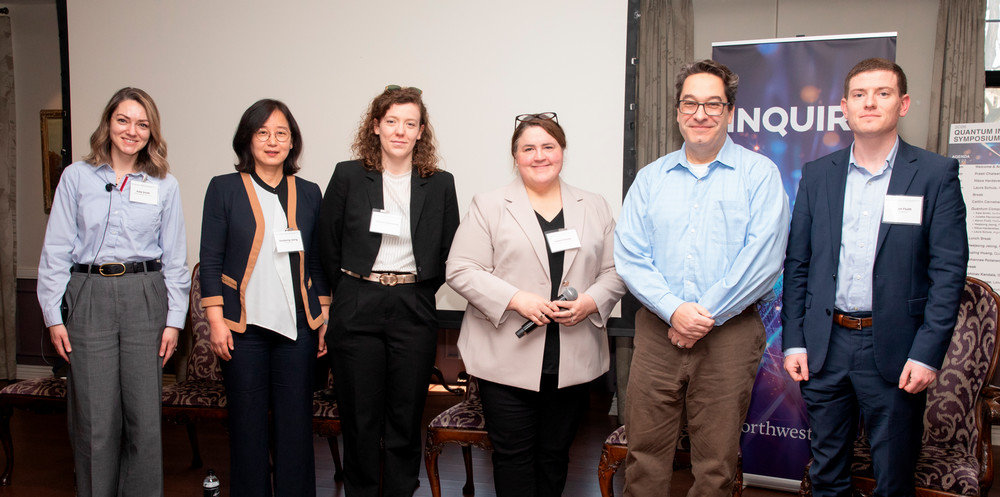
left to right: Kate Smith, Heejeong Jeong, Juliette Peyronnet, Laura Schulz, Nikos Hardavellas, Aaron Fluitt
The symposium also spotlighted Northwestern alumni helping shape the quantum sector. Yuping Huang — CEO and chairman of Quantum Computing Inc., professor of physics at Stevens Institute of Technology, and a former postdoctoral researcher and research faculty member at Northwestern — delivered an alumni entrepreneurship talk on quantum networking and communications, tracing a path from foundational research to commercialization.
“Quantum technology will change the world,” but only once it becomes a routine part of the business world, Huang said. “Some may doubt it will ever happen, but I’m certain it will.” He added that Quantum Computing Inc.’s mission is to place this capability “in the hands of a billion people, moving quantum out of the lab and into everyday use.”
Johannes Pollanen, who earned his Ph.D. at Northwestern and now leads the Laboratory for Hybrid Quantum Systems at Michigan State University while serving as chief science officer and co-founder of Chicago-based EeroQ, spoke about the company’s effort to build a scalable quantum processor based on electrons trapped above superfluid helium in very low temperatures. His talk highlighted both the scientific promise of the approach and the technical milestones still needed to bring it closer to large-scale computing.
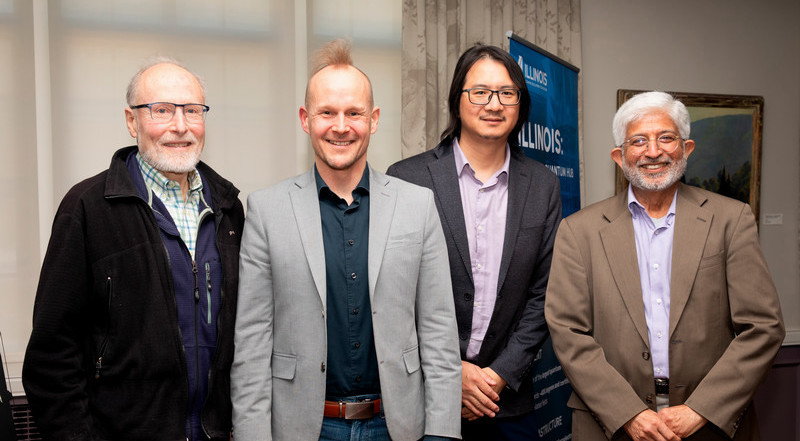
left to right: William Halperin, Johannes Pollanen, Yuping Huang, Prem Kumar
“People have had this idea around for a long time, building qubits out of electrons on helium,” Pollanen said. “I'm happy to tell you that we're the first to actually be able to couple to the charged unit states of these electrons.”
The event concluded with a poster session and reception, where conversations continued across academia, industry, and the public sector. By day’s end, one message had come through clearly: quantum progress will depend not only on scientific breakthroughs, but also on the partnerships, infrastructure, and talent needed to move those breakthroughs into the world.
For Northwestern, the symposium and the entire week’s programming were a showcase and a statement of intent: the University aims to help build the future of quantum.