CRS Scientist Spotlight on Karen Velez
Karen Velez is an MS-RSM graduate student in Dr. Francesca Duncan's lab. Her research focus is on understanding the role of long lived proteins in the oocyte. As she enters into her second year of her thesis studies, Karen reflects on her time in the MS-RSM and CRS and how that has shaped her as a reproductive biologist.
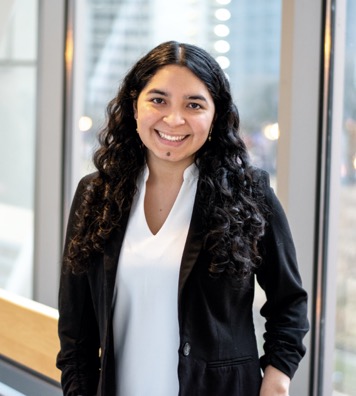
Name: Karen Velez
Position: MS-RSM Graduate Student
Mentor: Dr. Francesca Duncan, PhD
Thesis: Identification and characterization of extremely long-lived proteins in mouse ovaries and oocytes
What brought you to join the CRS community and what is your current position?
I’m a second-year master student in the Reproductive Science and Medicine program. I became interested in endocrine and reproductive systems after an undergraduate lecture in my animal physiology class where we were learning about the positive feedback loop of oxytocin during childbirth. After graduating with my bachelor’s in Biology from Western Connecticut State University, I decided to work as a medical assistant in a gynecology office. Here, I realized that I had a passion in learning about the reproductive system and I knew I needed to find a program that would teach me about the reproductive system, but also train me as a reproductive scientist. The curriculum of the MS-RSM program had exactly what I was looking for. I knew this was the right program for me after looking at the extensive list of CRS faculty. The CRS faculty assured me that I would be part of community that had experts in different areas of reproductive science and medicine.Could you describe your research?
I am a member of the Duncan Lab, which focuses on investigating the age-associated decline in female gamete quantity and quality. My thesis project is a relatively new area of research for the lab because I am part of an R21 project that is focusing on the relationship between proteostasis, or protein homeostasis, and ovarian aging. The R21 project is a collaboration between Dr. Francesca Duncan and Dr. Jeffery Savas. Previously using a whole-animal stable isotope labeling method, Dr. Savas identified proteins in rat neurons that did not turnover, which are referred to as extremely-long lived proteins. Studies have shown these long-lived proteins may play a role in the age-dependent functional decline of tissues. As of now, the only well-known extremely long-lived protein that exists in the oocyte is REC8. Harnessing Dr. Savas’ experimental technology and Dr. Duncan’s expertise in female reproductive biology and ovarian aging, we are working to identify other extremely-long lived proteins in the ovary.
Based on preliminary data, lamin B1 is a putative extremely long-lived protein in the ovary. Lamin B1 is part of the lamin meshwork located in the inner membrane of the nuclear envelope. Lamin B1 has various functions such as gene activation and silencing, DNA replication/repair, chromatin organization, apoptosis, and is a marker for cellular senescence. I am currently working on characterizing lamin B1 in the ovary and oocyte of young and old mice. For my future plans, I will be conducting functional assays to investigate the function of lamin B1 in oocytes and whether there is a functional decline with age.
What aspect(s) of CRS do you find most valuable?
Being connected to a community of scientists with a passion in reproductive science is what I find most valuable. During these difficult times, the CRS has worked on making networking events virtual, so that trainees such as myself, can have the opportunity to network and talk to other scientists about their research.
What has been the most valuable aspect to your training as a reproductive scientist?
The most valuable aspect of my training is learning to ask for feedback. Feedback is crucial in learning and growing into a well-rounded scientist. My mentor has also taught me to accept that it is okay if an experiment fails during my first try. It is easy to become discouraged after spending hours or days on an experiment that ends up not working. My mentor has really encouraged all her trainees to always keep notes about everything you do during an experiment so then you can potentially identify what went wrong or modify the protocol.
What is one piece of advice you would give to young scientists starting in their journey in science
Ask questions and be open to feedback. Asking questions may be intimidating starting off as a new scientist, but it is one of the ways you get to learn and expand your knowledge. Again, I can’t stress this enough, accepting feedback is important so that you can identify areas you can improve on.
What do you think will be the next big contribution in the reproductive biology field?
The next big contribution will be identifying extremely long-lived proteins in the ovary and oocyte and determining the mechanism by which they lead to aging!
What hobbies do you have outside of the lab?
I enjoy watching K-dramas, listening to music, and playing video games. I also enjoy playing tennis when the weather isn’t so harsh!