Alumni Spotlight on Dr. Teerawat Wiwatpanit
The most valuable aspect to my training in CRS was the ability to expand my knowledge and explore new territories.”
Dr. Teerawat Wiwatpanit, PhD
Dr. Teerawat (Tee) Wiwatpanit, PhD is a CRS Alum, former postdoctoral fellow of Dr. J. Julie Kim, PhD, the Co-Director of CRS. Tee is now an Principal Investigator in Thailand at the National Center for Genetic Engineering and Biotechnology, where he is conducing research on the Zika virus vertical transmission in pregnant women using organoids and has recently partnered with the World Health Organization to successfully raised funds to support his Zika virus research.
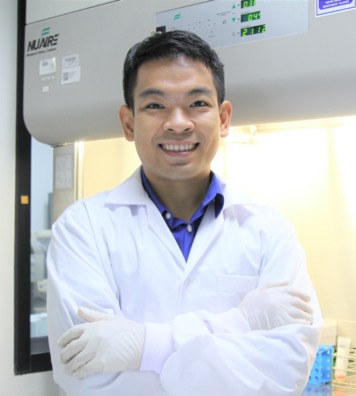
Name: Dr. Teerawat Wiwatpanit, PhD
Postdoctoral Advisor: Dr. J. Julie Kim, PhD
Current Position: Principal Investigator at the National Center for Genetic Engineering and Biotechnology, Thailand
What is your connection to the CRS community (mentor and position) and what is your current position is?
I was a postdoc fellow in Dr. Julie Kim’s lab back in 2018-2019. I am currently a PI at Frontier Biodesign and Biomolecular Engineering Research Team, National Center for Genetic Engineering and Biotechnology, Thailand
Could you describe your current research?
My current work focuses on generations of organoids and culture systems for disease modeling and drug testing. The main project in the lab is to utilize endometrial and trophoblast organoids to study the mechanism of Zika virus vertical transmission, and to test patient-derived antibodies for their ability to neutralize the virus and block this process. We also collaborate with other labs to develop liver organoids to study malaria liver-stage and dengue virus infections, and to study pharmacokinetics of different candidate drugs.
What aspect(s) of CRS did you find most valuable?
The sense of community within CRS. You can always get help and advice from people in CRS as well as just hang out with them.
What has been the most valuable aspect to your training as a reproductive scientist in CRS?
The most valuable aspect to my training in CRS was the ability to expand my knowledge and explore new territories. I was working on the collaborative project modeling PCOS on microfluidic system. With this, I got to work with different labs and learned about tissue engineering (we worked with endometrial, fallopian tube, liver, islets and fat organoids). Although we were an endometrial lab, I got to learn and work with different systems and organs for the project. That was what got me interested in tissue engineering later on.
What would you recommend to junior scientists in order for them succeed in their scientific careers?
Bad things happen in experiments and that’s ok. Don’t be afraid to try new things and fail. There had been so many failed attempts for me personally to generate and characterize the endometrial organoids back in the Kim lab. But, eventually, you will get it right.What do you think will be the next big contribution in the reproductive biology field?
Multi-organ chip. People at CRS are already working on this to incorporate different parts of the female reproductive tract as well as other relevant tissues in the form of organoids. I think this will open doors for so many research questions.
Do you have any notable stories from your time in CRS?
This has to be about a month or so after I started my position in Dr. Kim’s lab. I was fortunate to be on this big UH3 project on modeling PCOS in microfluidics with a lot of CRS members like Dr Kim, Dr Woodruff, Dr Urbanek, to name a few, as well as a bunch of clinicians, and PIs from different intuitions. When I got to the first “team meeting”, it turned out to be a progress update teleconference with NIH. That felt like a big deal to me at the time, and I got so nervous as I had graduated a just few weeks before joining the lab. All I could think was: “I’ve made it to the adult table.” Looking back, that was kind of funny because we had meetings like that all the time later, but that was my most memorable moment in CRS when I told myself that “yep, you’ve made it.”