Alumni Spotlight on Dr. Rexxi Prasasya
At some point in your training, you will find your scientific voice, a good mentor will bolster this nascent voice and assist you in gaining self-assurance. Remember, your relationship with your graduate school community does not end when you leave NU. Keep up with your networks, you never know when you will need them in your future endeavor.”
Dr. Rexxi Prasasya, PhD
Dr. Rexxi Prasasya, PhD, is a CRS Alumna and former team member of Dr. Kelly Mayo, PhD, who received her PhD from NU in 2018. She is now a postdoctoral fellow at the University of Pennsylvania in Philadelphia in the lab of Dr. Marisa Bartolomei, PhD where she is conducing research on the life-cycle of imprinting marks in the mammalian germline and is a recent recipient of an NIH NRSA postdoctoral fellowship.
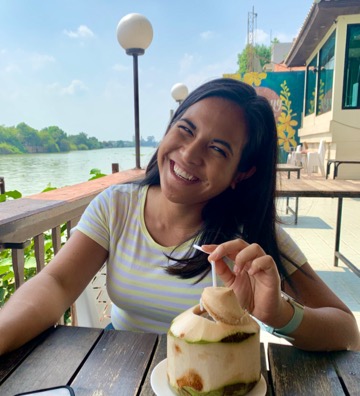
Name: Dr. Rexxi Prasasya, PhD
PhD Advisor: Dr. Kelly Mayo, PhD
Thesis Title: Regulation of Ovarian Granulosa Cell Proliferation and Differentiation by the Notch Signaling Pathway
Current Position: Postdoctoral Fellow at the University of Pennsylvania
What is your connection to the CRS community and what is your current position?
I was an IBiS graduate student in lab of Dr. Kelly Mayo until 2018. I am currently a postdoc at University of Pennsylvania Epigenetics Institute working in the lab of Dr. Marisa Bartolomei.
Could you describe your current research/studies?
I am currently studying the life-cycle of imprinting marks in the mammalian germline. Genomic imprinting is a form of epigenetic regulation that restricts expression of a critical subset of genes to one parental allele. As such, genomic imprinting forms the fundamental basis for the requirement of bi-parental nuclear contribution to produce viable mammalian embryos. My research interest lies in dissecting the mechanisms of how these imprinting marks, which include DNA methylation and histone modifications, are erased and rewritten during germline development to ensure the production of viable mature eggs and sperm.
What aspect(s) of CRS did you find most valuable?
As a trainee, being involved in the CRS community provided much mentorship but in traditional and non-traditional sense. CRS faculty were invaluable members of my thesis committee. Presenting in the Reproductive Research Update gave me regular feedbacks on my thesis progress as well as helped in preparing for conference talks. Participating in the planning committee for the CRS summit was an enriching experience to my graduate school career that I would not had the opportunity otherwise if I was not a member of the CRS. Most important of all, the lifelong friendships that I gain from being a member of the NU reproductive science community are ones that I will cherish the most.
What has been the most valuable aspect to your training as a reproductive scientist in CRS?
The NU CRS community has a strong sense of camaraderie. You can always find help within the community, whether it is to find reagents, learn new techniques, or to ask for career advice. CRS members are very well connected to the reproductive science community at large and they do not hesitate to introduce you, as a young trainee, to prominent scientists during national meetings, something that I truly appreciated and continue to emulate in the next stages of my career.
What would you recommend to junior scientists in order for them succeed in their scientific careers?
Your strategy in going through your training should be to not get burn out. Identify both traditional and non-traditional mentors in your training that will re-build your confidence as you try to clone that constructs for the umpteenth time over. Listen and be open to your mentors’ suggestions. At some point in your training, you will find your scientific voice, a good mentor will bolster this nascent voice and assist you in gaining self-assurance. Remember, your relationship with your graduate school community does not end when you leave NU. Keep up with your networks, you never know when you will need them in your future endeavor.
Choose a research topic that excites you, one that is not necessarily trending on #AcedemicTwitter. Good science will always find a home, whether it is a journal-home or a funding-home. If you are excited and confidence about your research, you will find a way to communicate that excitement in your grants and papers, and as always, excitement is contagious! Being passionate about a research field will also motivate you as you are spending your 12th hour in the lab in the eve of a holiday trying to get that one last assay done in preparing for your thesis committee meeting (fine, Lou Malnati’s take-out also helped a lot with this).
What do you think will be the next big contribution in the reproductive biology field?
In vitro gametogenesis, germline genetic modifications, and the ethical dilemmas that accompany progress made in both of these fields.
Do you have any notable stories from your time in CRS?
Attending scientific meetings with the CRS crowd is always guaranteed for a good time. Pulling Dr. Neena Schwartz into an Endocrine Society meeting photobooth while wearing a crown prop as a second year grad-student was an early indication of the life-long relationships that I would have gain within the CRS during my training. Playing reproductive science trivia at CRS holiday parties was sure to turn many passerby’s heads in Lurie’s lobby.